A Short History of Sequins
From a pharaoh’s tomb to a moonwalk, by way of Venetian coins and a few that melted in the rain. Why we have never stopped wanting to sparkle.
By the WHATAQUEEN desk · November 13, 2026 · 3 min read
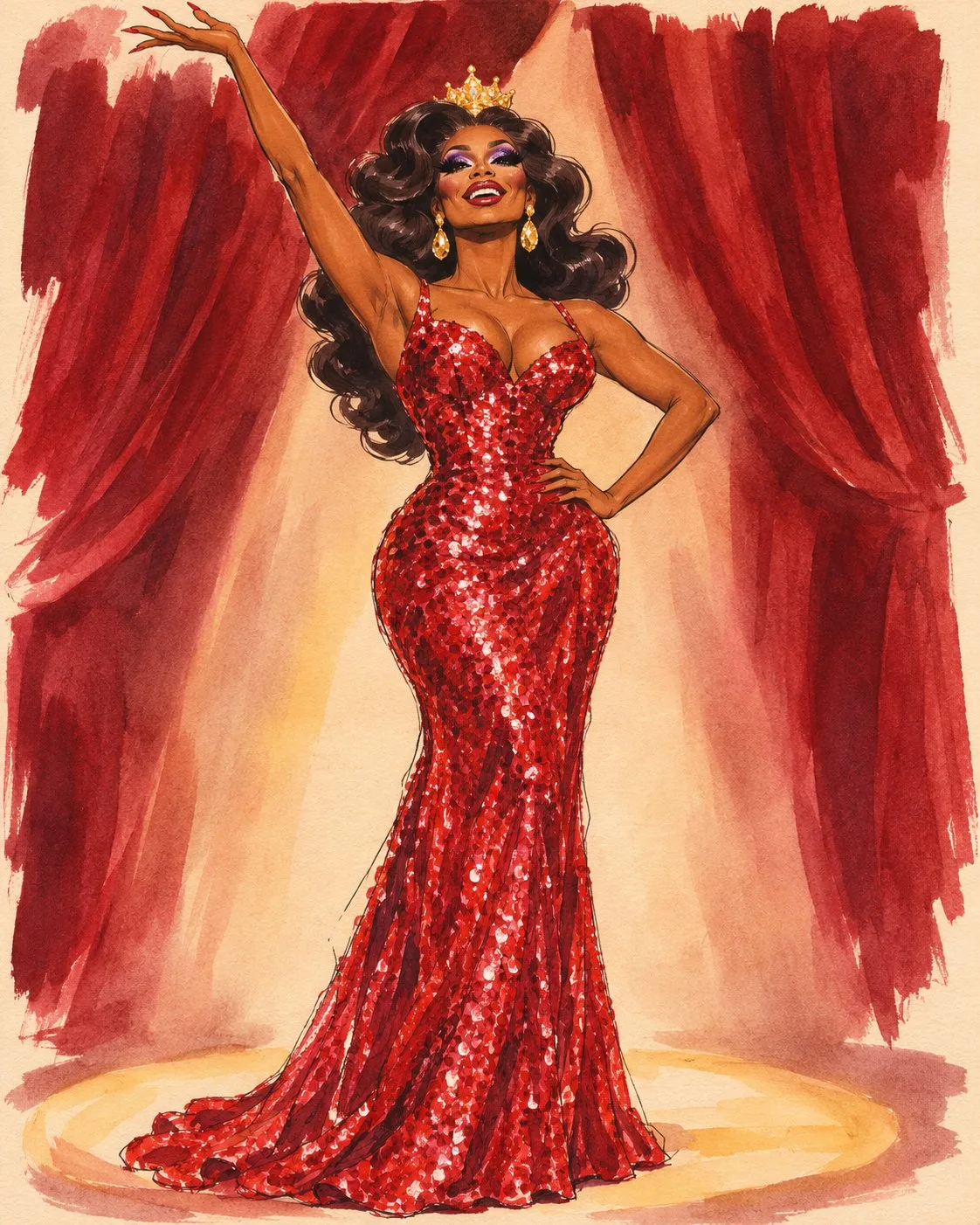
Somewhere right now, someone is sitting on the floor with a needle, a spool of thread and a bowl of tiny shining discs, sewing them on one at a time. Our own Miss Vera Velour sewed 4,000 of them for one Saturday night. People have been doing some version of this for a very, very long time.
Older Than You Think
Sequins made from nautilus shell, found in Indonesia, are thought to be around 12,000 years old. Gold sequins were decorating clothing in the Indus Valley around 2500 BC. And when Tutankhamun’s tomb was opened in 1922, his garments were found sewn with solid gold sequin-like discs, likely meant to make sure he arrived in the afterlife looking his best. A man after our own heart.
A Word That Started as Money
The name comes from coins. Venice minted a gold coin known locally as the zechin, and the French turned it into “sequin.” The connection makes sense. For centuries, sewing coins and metal onto clothes was a way to wear your wealth where everyone could see it. In England, they took a different route and called them spangles, a word we would like to bring back immediately.
Kings, Queens and Leonardo
When Henry VII was crowned in 1485, London goldsmiths supplied silver and gilt spangles for the occasion. In 1502, Elizabeth of York paid a coppersmith for “spangelles, settes, square pieces, stars, drops, and points.” Around the same time, Leonardo da Vinci sketched a machine of levers and pulleys for punching little discs out of metal. It was never built, but it tells you something. Even Leonardo thought sparkle deserved better engineering.
By the early 1600s, sequined waistcoats were the height of court fashion. A museum reproduction of one, based on a garment at the Victoria and Albert Museum, carries about 10,000 hand-stitched sequins. Vera, darling, you are in excellent company.
The Roaring Twenties
Tutankhamun’s tomb set off a wave of Egypt-inspired fashion, and metal sequins swung right along with it on flapper dresses. Paris houses like Callot Soeurs had already been making evening gowns covered entirely in them. The trouble was weight. Metal is heavy, and a fully sequined dress is a commitment.
The Ones That Melted
In the 1930s, someone had a lighter idea: sequins made of electroplated gelatin. They were wonderfully light. They were also, essentially, made of the same stuff as dessert. Gelatin sequins melted if they got wet or too warm, which is not ideal for an evening of dancing. History does not record how many party dresses dissolved on the way home in the rain, but we think about it often.
The fix came from an unlikely place. Eastman Kodak, which used cellulose acetate in its film, worked with Herbert Lieberman to make acetate sequins. They were beautiful but brittle. Lieberman’s company, Algy Trimmings, went on to become the biggest sequin maker around.
Plastic Fantastic
In 1952, DuPont invented Mylar, a clear polyester film, and it was used to protect colored plastic sequins so they could survive the wash. Later, vinyl took over because it was tougher and cheaper. That’s the sequin most of us know today: light, bright, washable, and slightly prone to curling if you leave it in a hot car.
Showtime
Once sequins were cheap and sturdy, they belonged to the stage. In the late 1960s, groups like The Supremes made them part of the sound of an era. And in 1983, Michael Jackson performed “Billie Jean” on the Motown 25 television special in a black sequined jacket and a single rhinestone glove, moonwalked in front of roughly 47 million viewers, and made sparkle feel like electricity.
Why We Keep Wearing Them
From gold in a pharaoh’s tomb to vinyl on a drag stage, a sequin does the same simple thing. It catches light and throws it back. Put on enough of them and you become the brightest thing in the room, for a few hours at least. As Queenie put it in her very first column, “Sequins do not check ID.” They never have.
Got something sparkly? Post it as a moment, and tell us how many you think are on it. Nobody has to count.
The Receipts
Every fact, and where we found it. Curious? Go deeper.
- Smithsonian Magazine, “A History of Sequins From King Tut to the King of Pop”: Tutankhamun, Leonardo’s sketch, the 17th-century waistcoats, the 1920s, gelatin and acetate sequins, Herbert Lieberman and Algy Trimmings, Mylar in 1952, Michael Jackson in 1983. Go deeper at smithsonianmag.com
- Wikipedia, “Sequin”: the Venetian zechin, nautilus-shell sequins in Indonesia, the Indus Valley, Henry VII’s coronation, Elizabeth of York’s spangles, Callot Soeurs, vinyl, The Supremes. Go deeper at en.wikipedia.org
- Miss Vera Velour is a member of the WHATAQUEEN Cast, our illustrated residents. She is drawn, not a real person.