The Skirt That Wanted to Twirl
How the full-skirted 1950s look was born: one Paris show, twenty yards of fabric, a furious public, and a woman who could not sew who made a skirt from a single circle of felt.
By the WHATAQUEEN desk · November 13, 2026 · 3 min read
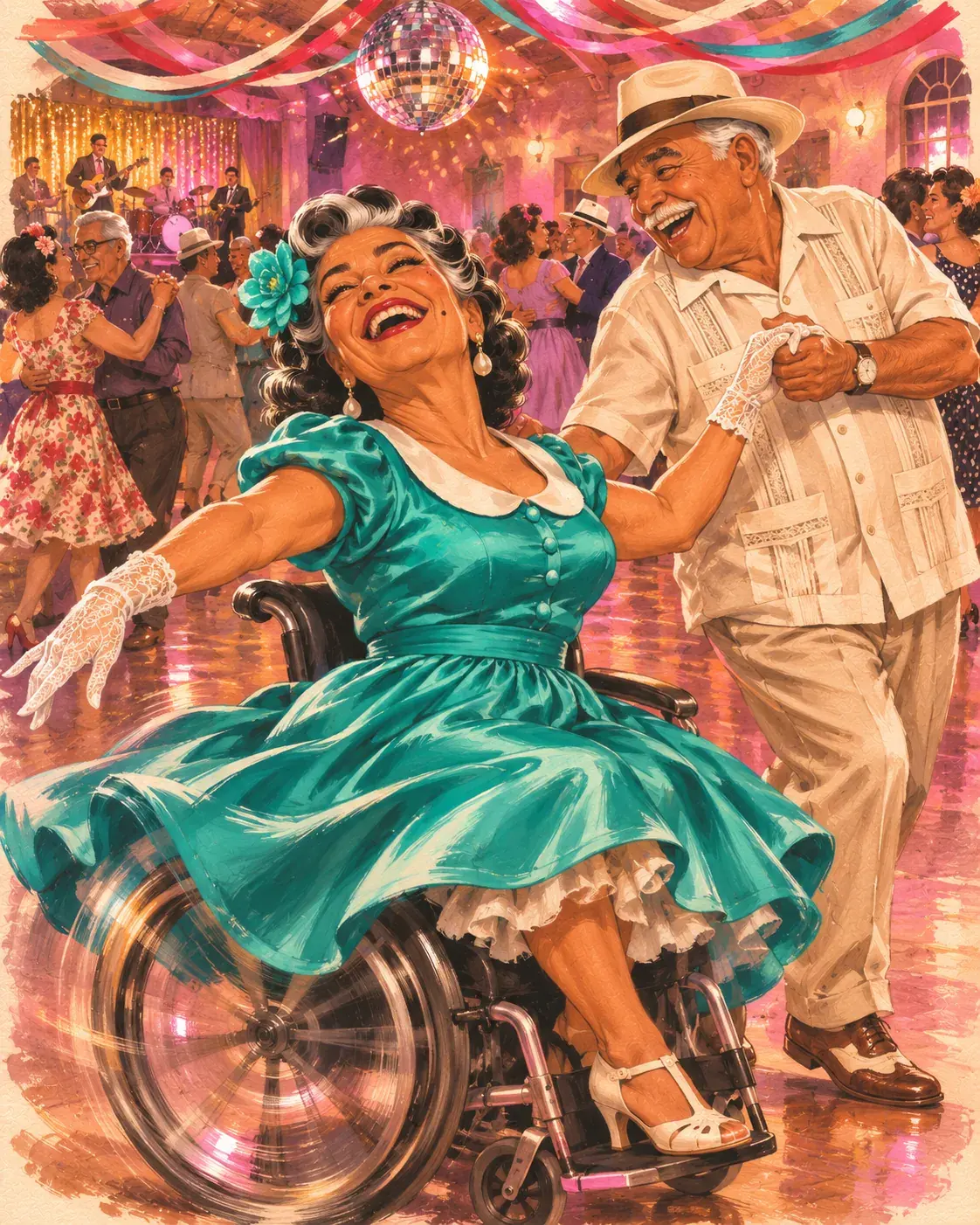
Every Saturday at oldies night, our Rosa spins her wheelchair across the dance floor in a turquoise satin swing dress, and the skirt does the thing it was designed to do. It flies. Don Ernesto cannot keep up. Neither, frankly, can the rest of the room. So where did a skirt like that come from? It has a surprisingly dramatic origin story.
A Show That Changed Everything
On 12 February 1947, a designer named Christian Dior showed his very first collection in Paris, at 30 Avenue Montaigne. For years, women had worn practical clothes cut close to save fabric during the war. Dior sent out the opposite: soft rounded shoulders, a tiny cinched waist and skirts so full they swayed when the models walked.
Carmel Snow, the editor of Harper’s Bazaar, reportedly exclaimed, “It’s such a New Look! It’s quite a revolution, dear Christian!” The name stuck. It is still called the New Look today, which is a very long time for anything to stay new.
Twenty Yards of Trouble
The skirts used a lot of fabric. One of Dior’s 1947 skirts took about twenty yards, and his “Chérie” dinner dress has over 13½ yards pleated into the waist alone. For people who had lived through years of rationing, this felt almost rude. Critics called it inconsiderate. Others complained it dragged women backwards, bringing back corsets and making it harder to move.
And yet, women wanted it. After years of making do, a skirt that swished was a kind of joy you could wear. Sometimes the most frivolous thing is exactly what people need.
Meanwhile, at a Christmas Party in California
Here is our favorite part. That same year, a young woman in California named Juli Lynne Charlot was invited to a Christmas party and had nothing to wear. She also, by her own account, could not really sew. Her mother had a factory that used felt, so she took some felt, cut one big circle with a hole in the middle for her waist, and that was the skirt. No seams. Felt doesn’t fray, so it didn’t even need hemming.
She added holiday appliqués just for fun. People loved it. Soon she was selling felt circle skirts in Beverly Hills boutiques, and when someone asked for one with dachshunds on it, the dog skirts took off. The poodle became the most famous of all, and the poodle skirt was born. All because somebody had a party to go to and refused to stay home.
Why a Circle Is Magic
Try this. Cut a circle out of paper, cut a small hole in the center, and hold it up by the hole. The edges hang in soft folds all the way around. Now spin. The edges lift and fly out. That’s a circle skirt. Because the fabric is a full circle, every bit of it is free to swing, which is why these skirts were made for the jive, the jitterbug and rock and roll. And why Rosa wins every Saturday.
Wear It Your Way
- Twirl test. In the fitting room, spin once. If the skirt lifts, it’s a keeper. Dignity optional.
- Add volume underneath. A layer of tulle or a petticoat makes the skirt stand out even when you’re standing still.
- Cinch the waist. A belt is what turns “a full skirt” into “the look.”
- Thrift it. Full skirts from every decade since the 1950s turn up in vintage shops. Ask Mariselle. Actually, don’t. She’ll get there first.
Have a skirt that twirls? Post a moment mid-spin, and tag it Night Out or Thrifted. Blurry counts. Blurry is the point.
The Receipts
Every fact, and where we found it. Curious? Go deeper.
- Europeana, “Les Couturiers: Christian Dior”: the 12 February 1947 show, Carmel Snow’s reaction, twenty yards of fabric, the rationing and feminist criticism. Go deeper at europeana.eu
- Google Arts & Culture, “Christian Dior: The New Look”: the Bar suit and the Chérie dress with over 13½ yards of fabric. Go deeper at artsandculture.google.com
- Folkwear, “How the Poodle Skirt Came to Be”: Juli Lynne Charlot, the 1947 Christmas party, the felt circle and the dachshunds. Go deeper at folkwear.com
- Rosa is a member of the WHATAQUEEN Cast, our illustrated residents. She is drawn, not a real person.