The Tie That Started on a Windy Day
A silver hatband, a gust of Arizona wind and three states that made it official. The surprisingly dramatic life of the bolo tie, Ray and Luca’s favorite accessory.
By the WHATAQUEEN desk · November 13, 2026 · 2 min read
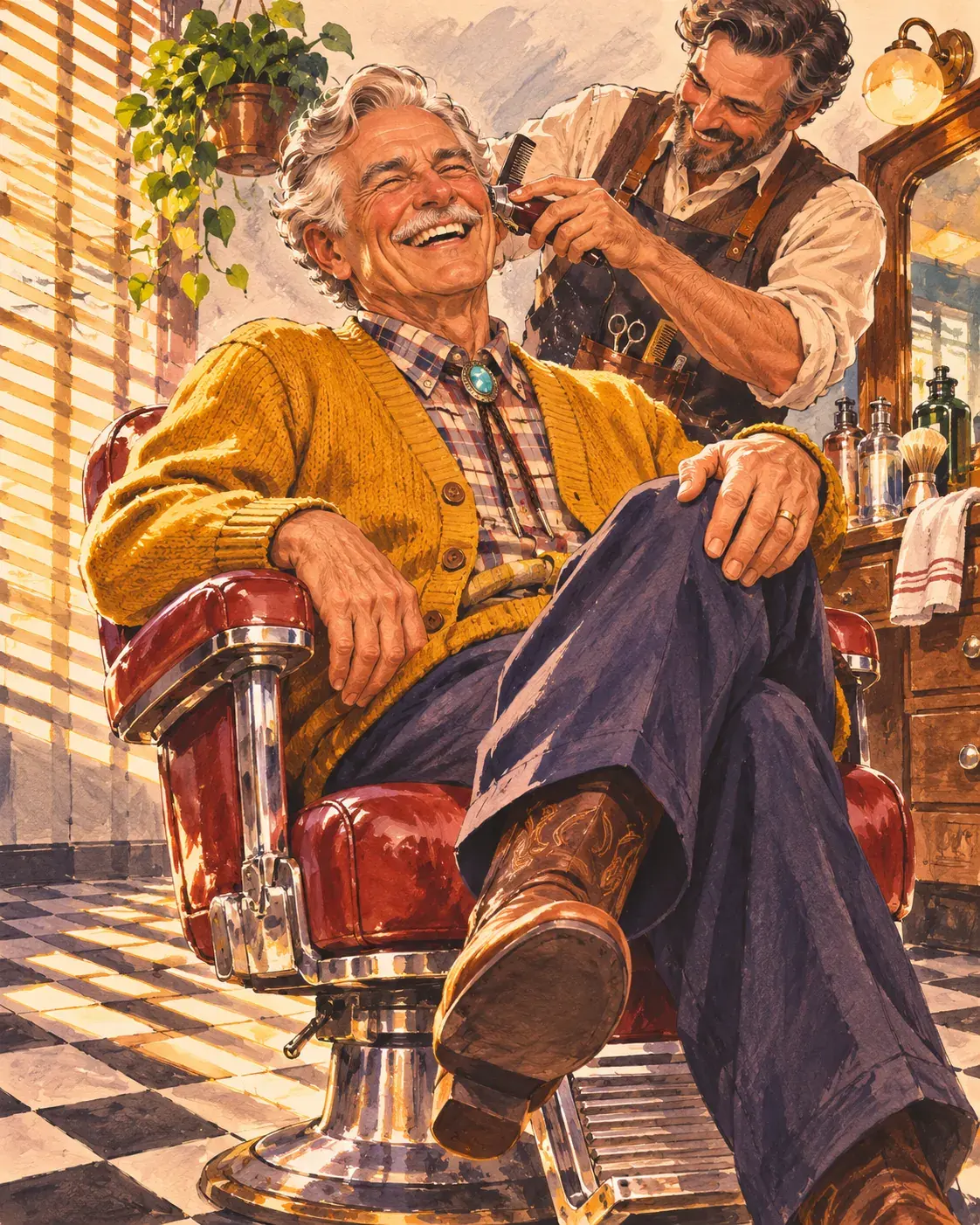
Look closely at Ray in the barber’s chair and you’ll spot it: a turquoise stone at his collar on a thin braided cord. Now look at Luca’s profile picture. Same idea, sixty years younger. A bolo tie is one of the few accessories that looks equally right on a grandfather and a teenager, and it has a great story.
A Gust of Wind in Wickenburg
The story most people tell goes like this. Sometime in the 1940s, a silversmith in Wickenburg, Arizona, named Victor Cedarstaff was out riding when the wind picked up. He didn’t want to lose the silver-trimmed band from his hat, so he slipped it around his neck. A friend told him it looked sharp. Cedarstaff went on to patent the design.
It’s a lovely origin story, and like a lot of lovely origin stories, it may not be the whole truth. Historians say the bolo’s exact beginnings are hard to pin down, and some believe Native American artists were making similar neckwear much earlier. What nobody disputes is where it took root: the American Southwest.
Where the Name Comes From
The word is usually traced to the boleadora, a throwing weapon of weighted cords used on the plains of South America. Which leads to the single most important fact in this piece, courtesy of a member of the Bola Tie Society of Arizona: “b-o-l-a is the tie and b-o-l-o is a knife.” Both spellings are used today. We will not be taking sides. Ray says bola. Luca says bolo. Thanksgiving is going to be interesting.
Small Clasp, Serious Art
A bolo has three parts: a braided cord, a decorative slide that sits at the collar, and metal tips on the cord’s ends. That slide is where the artistry lives. Native American silversmiths, including Navajo, Zuni and Hopi artists, have made some of the most admired bolos ever created, with turquoise, inlay and stamped silver. The Hopi designer Charles Loloma is among the celebrated names. When the Heard Museum in Phoenix put on an exhibition of Native American bolo ties, it showed 350 of them, vintage and contemporary.
Made It Official
Very few accessories get legislation. The bolo got three states. Arizona named it the official state neckwear in 1971. New Mexico and Texas both made it their official state tie in 2007. That means somewhere, in a government building, a bill about neckwear was debated, voted on and passed. We love that for everyone involved.
Why It Works on Everyone
A regular tie has rules: a knot, a length, a dimple, a strong opinion from your uncle. A bolo has one rule. Slide it up, slide it down. Wear it snug on a buttoned collar for something sharp, or loose on an open shirt for something relaxed. It’s genderless, ageless and easy to thrift, and the slide lets you carry a little piece of art right where people look first.
- The Ray. Pressed plaid shirt, cardigan, bolo snug at the collar. Dignified, with a twinkle.
- The Luca. Black shirt buttoned to the top, a big turquoise slide, attitude.
- The Night Out. Silk blouse, bolo worn low and loose like a pendant.
Got a bolo, a bola or a necklace you’re pretending is one? Post a moment and tell us the story behind the slide. Spelling arguments go in the notes.
The Receipts
Every fact, and where we found it. Curious? Go deeper.
- Deseret News (AP), “Arizona museum displays bolo ties, symbol of West”: the Victor Cedarstaff story, his patent, the hard-to-pin-down origins, Arizona in 1971, New Mexico and Texas in 2007, the Heard Museum’s 350 ties, Charles Loloma, and “b-o-l-a is the tie and b-o-l-o is a knife.” Go deeper at deseret.com
- Collectors Weekly, “Bolo Ties”: the 1940s Wickenburg origin, the boleadora name, and how the cord, clasp and silver tips go together. Go deeper at collectorsweekly.com
- Ray and Luca are members of the WHATAQUEEN Cast, our illustrated residents. They are drawn, not real people.